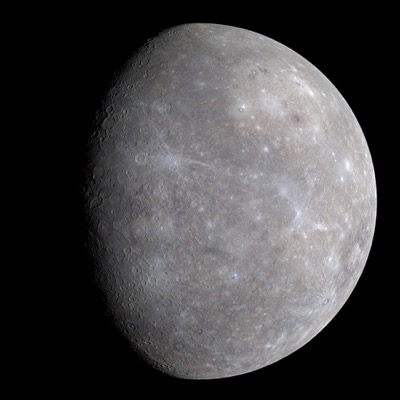
画像: NASA(パブリックドメイン)Image: NASA (public domain)
水星は太陽系で最も内側をめぐる、いちばん小さな惑星です。太陽からの平均距離は約0.39天文単位(およそ5,800万km)で、どの惑星よりも太陽に近い位置を回っています。
岩石でできた「地球型惑星」の仲間ですが、大気はほとんどなく、表面は月のようにクレーターだらけです。空気の層がほぼ無いため、隕石が衝突した跡がそのまま残り、太古からの傷あとを今も見ることができます。
水星は太陽のまわりを約88日で1周しますが、自転にはおよそ59日かかります。これは「自転3回のあいだに公転2回」という3対2の共鳴関係になっていて、太陽系のなかでも珍しいリズムです。
熱を閉じこめる大気がほとんど無いため、太陽に照らされる昼は約427℃まで上がる一方、夜は約-173℃まで冷えこみ、昼夜の寒暖差が極端です。表面には直径約1,550kmにもおよぶ巨大なクレーター「カロリス盆地」があり、激しい衝突の歴史を物語っています。
太陽系で最小の惑星 — 2006年に冥王星が準惑星に分類されて以降、水星が太陽系でいちばん小さな惑星になりました。直径は地球の半分にも届きません。
探査機による調査 — 水星をくわしく調べたのは、マリナー10号とメッセンジャーという2機の探査機です。これらが送り届けた画像から、表面の地形や成分が明らかになってきました。
観測のむずかしさ — 太陽にあまりに近いため、地上から水星を見るのは簡単ではありません。観測できるのは、夕方の西の空か明け方の東の空の、地平線近くの低いところに限られます。
水星は太陽系ステージの1番目(9ステージ中1つ目)、つまり最初のステージです。太陽のかけらを引力場で導き、水星へ到達させればクリアです。
このステージにはまだ隕石が登場しません。引力場を描いて太陽のかけらの軌道を作るという、ゲームの基本操作をじっくり覚えるための導入ステージです。ここで引力場の効き方の感覚をつかんでおくと、この先のステージがぐっと進めやすくなります。
Mercury is the smallest planet in the Solar System and the one that orbits closest to the Sun. Its average distance from the Sun is about 0.39 astronomical units (roughly 58 million km), placing it nearer the Sun than any other planet.
It belongs to the rocky "terrestrial" family of planets, but it has almost no atmosphere, and its surface is covered in craters much like the Moon. With virtually no air to erode them, the scars left by ancient impacts remain visible to this day.
Mercury circles the Sun in about 88 days, yet it takes roughly 59 days to spin once on its axis. This works out to a 3:2 resonance — three rotations for every two orbits — an unusual rhythm in the Solar System.
Because it has almost no atmosphere to trap heat, the sunlit day can climb to about 427°C while the night plunges to around -173°C, an extreme swing between hot and cold. Its surface bears a vast impact crater called the Caloris Basin, some 1,550 km across, a record of a violent collision long ago.
The smallest planet — Since Pluto was reclassified as a dwarf planet in 2006, Mercury has been the smallest planet in the Solar System. Its diameter is less than half that of Earth.
Explored by spacecraft — Mercury has been studied up close by two probes, Mariner 10 and MESSENGER. The images they returned revealed much about the planet's terrain and composition.
Hard to observe — Because it sits so close to the Sun, Mercury is not easy to spot from the ground. It can only be seen low in the sky, near the horizon, in the evening or just before dawn.
Mercury is the first stage of the solar system run (1st of 9) — the very first stage. Guide the Solar Shard with your gravity fields and bring it to Mercury to clear the stage.
No meteors appear yet on this stage. It is an introductory level, a place to take your time learning the core skill of drawing Gravity Wells to shape the Solar Shard's path. Getting a feel for how the fields work here will make the stages that follow much easier.
| 太陽からの平均距離Mean distance from Sun | 0.39 AU (≈5.79×10⁷ km) |
| 直径Diameter | 4,879 km |
| 公転周期Orbital period | 88 日88 days |
| 自転周期Rotation period | 約59 日~59 days |
| 昼夜の表面温度Surface temp. (day/night) | 約-173〜427℃~-173 to 427°C |
| 衛星の数Moons | 0 |
太陽系ステージに挑戦しようChallenge the solar system stages
PLAY NOW