VENUS

金星 ― 厚い雲に包まれた灼熱の双子星 Venus ― Earth's Scorching Twin
金星 / Venus

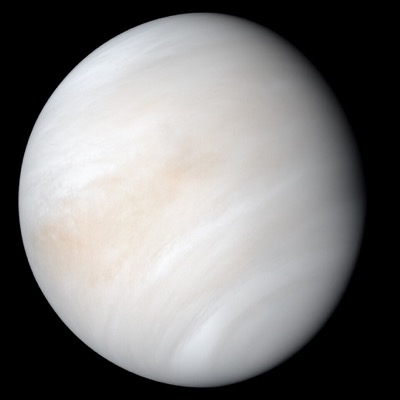
画像: NASA(パブリックドメイン)Image: NASA (public domain)

太陽からの距離DISTANCE
0.72 AU
直径DIAMETER
12,104 km
公転周期ORBIT
225日225 d
衛星MOONS
0

概要

金星は太陽系で内側から2番目をめぐる惑星です。大きさが地球とほとんど同じため、しばしば「地球の双子(双子星)」と呼ばれます。

その表面は分厚い雲にすっぽりと覆われていて、宇宙から眺めても地表のようすを直接見ることはできません。雲が太陽の光をよく反射するため、地球からは白く明るく輝いて見えます。

特徴

大気の主成分は二酸化炭素(CO2)で、地表での気圧は地球のおよそ90倍にもなります。これは深い海の底に潜ったときに受ける圧力に近いほどの大きさです。

分厚いCO2の大気が熱を閉じ込める「暴走温室効果」によって、表面の温度はおよそ465℃に達します。太陽にいちばん近い水星よりもさらに暑く、金星は太陽系で最も暑い惑星です。

自転の向きにも大きな特徴があります。金星は他の多くの惑星とは逆向き(逆行)に自転しており、しかもその速さがとてもゆっくりです。1回転に約243日もかかるため、自転にかかる時間が公転周期(約225日)よりも長い、めずらしい惑星になっています。

豆知識

明けの明星・宵の明星 — 金星は夜空で月の次に明るく輝く天体です。明け方の東の空や夕方の西の空にひときわ明るく見えることから、「明けの明星」「宵の明星」と呼ばれ、古くから人々に親しまれてきました。

探査機による観測 — 1974年に金星の近くを通過したマリナー10号をはじめ、これまで多くの探査機が金星を観測してきました。

雲の下のすがた — 厚い雲の下は、温度約460℃・気圧約90気圧という、とても過酷な環境です。地表に降り立った探査機もすぐに壊れてしまうほどのきびしさです。

Gravity Weaver での攻略

金星は太陽系ステージの2番目(9ステージ中2つ目)。太陽のかけらを引力場で導き、金星へ到達させればクリアです。

このステージにはまだ隕石が登場しません。引力場を描いて太陽のかけらの軌道を作る、いちばん基本の操作にじっくり慣れるためのステージです。どこに引力場を置けば太陽のかけらがねらった方向へ曲がるのか、落ち着いて感覚をつかんでおくと、この先のステージがぐっと楽になります。

Overview

Venus is the second planet from the Sun. Because it is almost exactly the same size as Earth, it is often called "Earth's twin."

Its surface is completely wrapped in thick clouds, so even from space you cannot see the ground directly. Those clouds reflect sunlight strongly, which is why Venus appears bright and white from Earth.

Features

The atmosphere is mostly carbon dioxide (CO2), and the pressure at the surface is about 90 times that of Earth — close to the crushing pressure deep beneath the ocean.

The dense CO2 atmosphere traps heat in a "runaway greenhouse effect," pushing the surface temperature to roughly 465°C. That makes Venus hotter than Mercury, the planet closest to the Sun, and the hottest planet in the solar system.

Its rotation is unusual too. Venus spins in the opposite direction to most other planets (retrograde), and it spins very slowly — a single rotation takes about 243 days. That means a Venusian day is actually longer than its year, since one orbit takes only about 225 days.

Trivia

Morning star and evening star — Venus is the brightest object in the night sky after the Moon. Shining brilliantly in the eastern sky at dawn or the western sky at dusk, it has long been known as the "morning star" and the "evening star."

Observed by spacecraft — Many probes have studied Venus, beginning with Mariner 10, which flew past it in 1974.

Beneath the clouds — Below the thick clouds lies a brutal world of about 460°C and roughly 90 atmospheres of pressure — harsh enough that landers reaching the surface are quickly destroyed.

In Gravity Weaver

Venus is the second stage of the solar system run (2nd of 9). Guide the Solar Shard with your gravity fields and bring it to Venus to clear the stage.

No meteors appear in this stage yet. It is a place to take your time and get comfortable with the most basic skill: drawing Gravity Wells to shape the Solar Shard's path. Learning calmly where to place a field so the Solar Shard curves the way you want will make the stages ahead much easier.

主なデータKey Data

太陽からの平均距離Mean distance from Sun0.72 AU
直径Diameter12,104 km
公転周期Orbital period225 日225 days
自転周期Rotation period約243日(逆行)~243 days (retrograde)
平均表面温度Mean surface temp.約465℃~465°C
衛星の数Moons0

太陽系ステージに挑戦しようChallenge the solar system stages

PLAY NOW