PLUTO

冥王星 ― 太陽系のはての準惑星 Pluto ― The Dwarf Planet at the Edge
冥王星 / Pluto

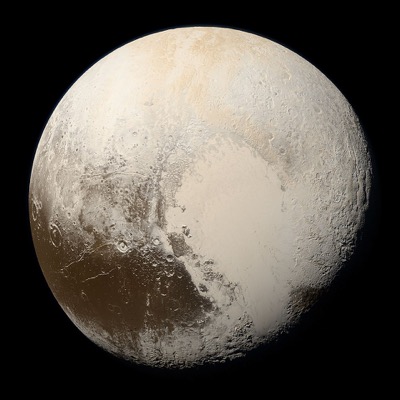
画像: NASA(パブリックドメイン)Image: NASA (public domain)

太陽からの距離DISTANCE
約39.5 AU~39.5 AU
直径DIAMETER
2,377 km
公転周期ORBIT
約248年~248 yr
衛星MOONS
5

概要

冥王星は太陽系の外縁部、海王星より外側に広がる「カイパーベルト」と呼ばれる領域にある天体です。太陽からの平均距離はおよそ39.5天文単位(地球と太陽の距離の約39.5倍)と非常に遠く、太陽系のはてをめぐっています。

かつては太陽系の9番目の惑星に数えられていましたが、似た大きさの天体が次々と外縁部で見つかったことを受け、2006年に「準惑星(dwarf planet)」という新しい分類へ位置づけが変更されました。岩石と氷でできた、地球の月よりも小さな世界です。

特徴

冥王星の表面には、窒素などが凍りついた氷でできた、ハートの形をした広大な平原が広がっています。発見者の名にちなんで「トンボー領域」と呼ばれ、冥王星のもっとも目を引く模様として知られています。

太陽から非常に遠いため、太陽のまわりを1周するのにおよそ248年もかかります。地球の月よりも小さく、表面はとても冷たく凍てついた世界です。遠く離れた太陽は、冥王星からは明るい星のひとつほどにしか見えません。

豆知識

二重天体のような関係 — 冥王星最大の衛星カロンは、冥王星のおよそ半分もの大きさがあります。2つは互いの引力で引き合いながら、共通の点のまわりを回り合っており、まるで「二重天体」のような関係になっています。

初めて間近で見た姿 — 2015年、探査機ニューホライズンズが史上はじめて冥王星に接近して通り過ぎました。それまでぼんやりとしか分からなかった冥王星の姿を、ハート模様や山脈までふくめて鮮明にとらえ、世界をおどろかせました。

Gravity Weaver での攻略

冥王星は太陽系ステージの最後(9ステージ中9つ目)。太陽のかけらを引力場で導き、太陽系のはてにある冥王星へ到達させればクリアです。

ここをクリアすると太陽系コンプリート。この先は深宇宙=星座のステージへと進みます。パルサー・流れ・星雲・板状の隕石といった、これまでに登場したしかけがすべて出そろう総仕上げの場面です。学んできた操作を組み合わせて、太陽系の旅を締めくくりましょう。

Overview

Pluto lies in the outer reaches of the solar system, in a region beyond Neptune known as the Kuiper Belt. Its average distance from the Sun is about 39.5 astronomical units — roughly 39.5 times the distance between Earth and the Sun — making it a world that orbits at the very edge of the solar system.

Pluto was once counted as the ninth planet, but as more bodies of similar size were discovered in the outer belt, it was reclassified in 2006 into a new category: the "dwarf planet." It is a small world made of rock and ice, smaller even than Earth's Moon.

Features

Pluto's surface holds a vast, heart-shaped plain made of frozen nitrogen and other ices. Named "Tombaugh Regio" after its discoverer, it is the most striking feature on the dwarf planet's face.

Because it is so far from the Sun, Pluto takes about 248 years to complete a single orbit. It is smaller than Earth's Moon, and its surface is an intensely cold, frozen landscape. From Pluto, the distant Sun appears as little more than one bright star among many.

Trivia

Almost a double world — Pluto's largest moon, Charon, is about half the size of Pluto itself. The two pull on each other and circle a shared point between them, behaving almost like a "double body."

Seen up close for the first time — In 2015, the New Horizons spacecraft made the first-ever close flyby of Pluto. It revealed in sharp detail — heart-shaped plains, mountains and all — a world that had until then been only a faint blur, astonishing observers around the globe.

In Gravity Weaver

Pluto is the final stage of the solar system run (9th of 9). Guide the Solar Shard with your gravity fields and bring it to Pluto, out at the edge of the solar system, to clear the stage.

Clearing it completes the solar system. From here the journey moves on to deep space — the constellation stages. This is the grand finale, where every hazard introduced so far — pulsars, currents, nebulae, and slab-like meteors — appears together. Combine everything you have learned to bring your tour of the solar system to a close.

主なデータKey Data

太陽からの平均距離Mean distance from Sun約39.5 AU~39.5 AU
直径Diameter2,377 km
公転周期Orbital period約248年~248 years
自転周期Rotation period約6.4日~6.4 days
分類Classification準惑星Dwarf planet
衛星の数Moons5(最大はカロン)5 (largest: Charon)

太陽系ステージに挑戦しようChallenge the solar system stages

PLAY NOW