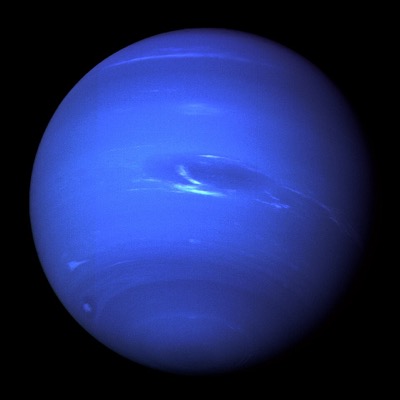
画像: NASA(パブリックドメイン)Image: NASA (public domain)
海王星は太陽系の最も外側をめぐる、内側から数えて8番目の惑星です。太陽からの平均距離はおよそ30天文単位(約45億km)と非常に遠く、太陽系の「最果て」に位置しています。
天王星とよく似た「氷惑星(氷の巨大惑星)」のひとつで、水素やヘリウムの大気にわずかに含まれるメタンが赤い光を吸収するため、深く鮮やかな青色に見えるのが大きな特徴です。地球からは肉眼で見ることができず、望遠鏡が必要なほど遠い天体です。
海王星では太陽系で最も激しい風が吹き荒れており、その速さは時速2,000kmにも達するといわれます。これは地球の暴風をはるかに上回る、想像を絶する暴風です。
かつて探査機が接近した際には、大気に「大暗斑(だいあんはん)」と呼ばれる地球サイズの巨大な渦が観測されました。木星の大赤斑のように長く居座る模様ではなく、現れたり消えたりする一時的な嵐だと考えられています。
太陽から非常に遠いため、太陽のまわりを1周するのにおよそ165年もかかります。発見されてから最初の1公転を終えたのは、ようやく21世紀に入ってからのことでした。
計算で予言された惑星 — 海王星は、天王星の動きがわずかに乱れることから「その外側に未知の惑星があるはずだ」と数学的に計算され、予言された位置どおりに発見された惑星です。望遠鏡で偶然見つかったのではなく、理論がまず居場所を言い当てたという点で特別な存在です。
逆向きに回る衛星トリトン — 最大の衛星トリトンは、海王星の自転とは逆向き(逆行)にめぐる珍しい衛星です。もともとは別の場所で生まれた天体が、海王星の引力に捕らえられたものだと考えられています。
唯一の訪問者 — これまでに海王星へ接近したことのある探査機は、1989年に飛来したボイジャー2号ただ1機だけです。私たちが知る海王星の姿の多くは、この一度きりの接近観測によって得られたものです。
海王星は太陽系ステージの8番目(9ステージ中8つ目)。太陽系クリアまであと一歩という難所です。
このステージでは、パルサー・流れ・星雲・板隕石といったギミックが出そろいます。それぞれの動きや力の向きを同時にさばく必要があり、引力場を描くタイミングと位置の見極めが本番になります。あわてず、まずは太陽のかけらをおびやかすギミックから優先して対処していきましょう。
Neptune is the outermost planet of the Solar System and the eighth from the Sun. Its average distance from the Sun is about 30 astronomical units (roughly 4.5 billion km) — placing it at the far frontier of the planetary realm.
Like Uranus, it is one of the "ice giants." Methane mixed into its hydrogen-and-helium atmosphere absorbs red light, giving Neptune its deep, vivid blue color. It is far too distant to see with the naked eye, requiring a telescope to observe.
Neptune is home to the most violent winds in the Solar System, with speeds reaching as high as 2,000 km/h — gusts that dwarf even Earth's fiercest storms.
When a spacecraft flew past, observers spotted an enormous Earth-sized storm in its atmosphere known as the "Great Dark Spot." Unlike Jupiter's long-lived Great Red Spot, these dark storms appear to come and go, lasting only for a time.
Because it lies so far from the Sun, Neptune takes about 165 years to complete a single orbit. It only finished its first full lap since its discovery in the early 21st century.
A planet predicted by math — Neptune was found because subtle disturbances in the motion of Uranus implied an unseen planet beyond it. Astronomers calculated where it should be, and it was discovered right where the math predicted — a world located by theory before the telescope ever found it.
The backward moon Triton — Neptune's largest moon, Triton, is unusual in that it orbits in the opposite direction to the planet's rotation (a retrograde orbit). It is thought to be a body that formed elsewhere and was later captured by Neptune's gravity.
The only visitor — Just one spacecraft has ever flown close to Neptune: Voyager 2, which passed by in 1989. Much of what we know about the planet comes from that single encounter.
Neptune is the eighth stage of the solar system run (8th of 9) — a tough trial just before clearing the system.
By this stage, the gimmicks are all in play: pulsars, currents, nebulae, and slab meteors. You have to juggle their motions and force directions at once, so reading the right timing and placement for your Gravity Wells truly matters here. Stay calm and deal first with whatever most threatens the Solar Shard.
| 太陽からの平均距離Mean distance from Sun | 30 AU |
| 直径(平均)Diameter (mean) | 49,244 km |
| 公転周期Orbital period | 約165年~165 years |
| 自転周期Rotation period | 約16時間~16h |
| 最大風速Top wind speed | 時速約2,100km~2,100 km/h |
| 衛星の数Moons | 16(最大はトリトン)16 (largest: Triton) |
太陽系ステージに挑戦しようChallenge the solar system stages
PLAY NOW