URANUS

天王星 ― 横倒しに転がる氷の惑星 Uranus ― The Sideways Ice Giant
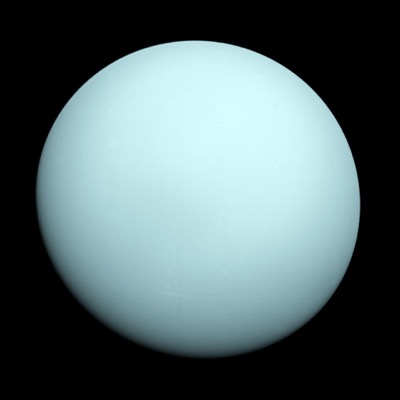
天王星 / Uranus

画像: NASA(パブリックドメイン)Image: NASA (public domain)

太陽からの距離DISTANCE
19.2 AU
直径DIAMETER
50,724 km
公転周期ORBIT
約84年~84 yr
衛星MOONS
28

概要

天王星は太陽系で内側から7番目をめぐる惑星です。木星や土星と同じく水素とヘリウムを主成分としますが、それに加えて水・メタン・アンモニアといった「氷」を多く含むため、海王星とともに「巨大氷惑星(氷惑星)」に分類されます。

大気にふくまれるメタンが、太陽光のうち赤い光を吸収して青と緑の光を反射するため、天王星は澄んだ青緑色(シアン)に見えます。望遠鏡でのぞくと、模様のほとんどない、のっぺりとした青い円盤のように見えるのも特徴です。

特徴

天王星の最大の特徴は、自転軸が公転面に対して約98度もかたむいていることです。ほかの惑星がコマのように立って自転するのに対し、天王星はほとんど横倒しのまま「転がる」ように太陽のまわりをめぐっています。

このため天王星では、季節の変化がとても極端になります。公転周期はおよそ84年で、その間、片方の極が数十年にわたってずっと昼であり続け、反対の極は同じだけの期間ずっと夜が続くという、地球では考えられない一年をくり返しています。

豆知識

望遠鏡で発見された最初の惑星 — 天王星は条件がよければ肉眼でもぎりぎり見える明るさですが、空をゆっくりとしか動かないため、長いあいだ惑星とは気づかれず、暗い星のひとつとして見すごされてきました。惑星だと確認されたのは望遠鏡が使われるようになってからで、天王星は望遠鏡によって発見された最初の惑星となりました。

たった一度の接近観測 — 天王星をこれまでに間近で観測した探査機は、ボイジャー2号ただ一機だけです。1986年に天王星のそばを通過し、私たちが知る天王星の姿の多くは、このときに送られてきたデータにもとづいています。

Gravity Weaver での攻略

天王星は太陽系ステージの7番目(9ステージ中7つ目)です。太陽のかけらを引力場で導き、青緑色の天王星へ到達させればクリアです。

このステージから、新たにパルサー(Pulsar)が登場します。これまでの流れ・星雲・板状の隕石に加えてパルサーまで加わるため、避けるべき要素がぐっと増えます。引力場を一気に描くのではなく、それぞれの障害の動きを見きわめながら、少しずつ太陽のかけらの軌道を整えていくと安定して通過できます。

Overview

Uranus is the seventh planet from the Sun. Like Jupiter and Saturn, it is made mostly of hydrogen and helium, but it also holds a large amount of "ices" such as water, methane, and ammonia — so, together with Neptune, it is classed as an "ice giant."

Methane in its atmosphere absorbs the red part of sunlight and reflects the blue and green, giving Uranus its clear cyan, blue-green color. Through a telescope it appears as a smooth, almost featureless blue disk.

Features

The most striking thing about Uranus is that its rotation axis is tilted roughly 98 degrees relative to its orbital plane. While other planets spin upright like a top, Uranus lies almost on its side and "rolls" around the Sun.

This gives it extreme seasons. Its orbit takes about 84 years, and over that time one pole stays in daylight for decades on end while the opposite pole is locked in darkness for just as long — a year unlike anything on Earth.

Trivia

The first planet found by telescope — Under good conditions Uranus is just barely visible to the naked eye, but because it moves so slowly across the sky, it was long mistaken for an ordinary faint star. It was only recognized as a planet in the telescope era, making Uranus the first planet ever discovered with a telescope.

Visited just once — Only a single spacecraft, Voyager 2, has ever observed Uranus up close. It flew past in 1986, and much of what we know about the planet comes from the data returned during that brief encounter.

In Gravity Weaver

Uranus is the seventh stage of the solar system run (7th of 9). Guide the Solar Shard with your gravity fields and bring it to the blue-green Uranus to clear the stage.

From this stage onward, a new hazard appears: the Pulsar. On top of the existing flows, nebulae, and slab-like meteors, the pulsar adds yet another thing to avoid. Rather than drawing your gravity fields all at once, read the motion of each obstacle and shape the Solar Shard's path bit by bit to pass through reliably.

主なデータKey Data

太陽からの平均距離Mean distance from Sun19.2 AU
直径(平均)Diameter (mean)50,724 km
公転周期Orbital period約84年~84 years
自転周期Rotation period約17時間(逆行)~17h (retrograde)
自転軸の傾きAxial tilt約98度~98°
衛星の数Moons28

太陽系ステージに挑戦しようChallenge the solar system stages

PLAY NOW