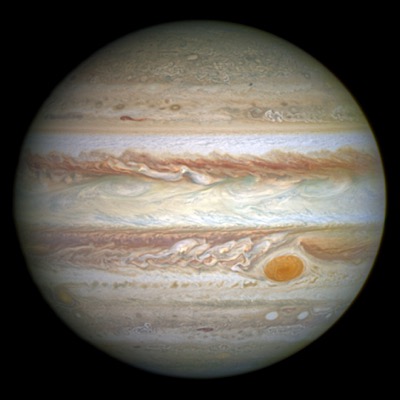
画像: NASA(パブリックドメイン)Image: NASA (public domain)
木星は太陽系で内側から5番目をめぐる、太陽系で最大の惑星です。地球のような岩石の地面を持たず、主に水素とヘリウムでできた「ガス惑星」に分類されます。
その大きさは桁外れで、内部に地球を1,300個以上も詰め込めるほどの体積があります。質量も太陽系のほかのすべての惑星を合わせたよりずっと大きく、まさに「惑星の王」と呼ぶにふさわしい存在です。
木星の表面に見える明るい帯と暗い帯の縞模様は、高速で流れる大気の動きが描き出したものです。なかでも有名な「大赤斑(だいせきはん)」は、地球がすっぽり入ってしまうほど巨大な嵐で、少なくとも数百年は続いていると考えられています。
これほど大きな惑星でありながら、木星の自転はとても速く、わずか約10時間で1回転します。これは太陽系の惑星の中で最も速い自転で、その遠心力のために木星は赤道方向にふくらみ、やや扁平な形をしています。
木星は非常に多くの衛星を従えています。なかでも有名なのが、1610年にガリレオ・ガリレイが発見した4つの大きな衛星、イオ・エウロパ・ガニメデ・カリスト(ガリレオ衛星)です。
このうちエウロパは、厚い氷の地殻の下に液体の海をたたえていると考えられており、地球以外で生命が存在する可能性のある場所として、研究者たちの大きな注目を集めています。
木星は太陽系ステージの5番目(9ステージ中5つ目)。太陽のかけらを引力場で導き、木星へ到達させればクリアです。
このステージでは、流れ(Stream)と星雲(Nebula)の要素が組み合わさって登場します。太陽のかけらは流れに押されながら星雲の影響も受けるため、軌道の管理が少しずつ難しくなっていきます。引力場を描くタイミングと位置をていねいに見極め、太陽のかけらの進路を先読みして整えていきましょう。
Jupiter is the fifth planet from the Sun and the largest in the entire solar system. It has no solid rocky surface like Earth's; instead it is a "gas giant," made up mainly of hydrogen and helium.
Its scale is staggering — you could fit more than 1,300 Earths inside it. Its mass is far greater than that of all the other planets in the solar system combined, which is why it has earned the title "King of the Planets."
The bright and dark bands striping Jupiter's face are traced out by the fast-moving currents of its atmosphere. The most famous of these features, the Great Red Spot, is a storm so huge that the entire Earth could fit inside it — and it is thought to have raged for at least several centuries.
Despite its enormous size, Jupiter spins remarkably fast, completing one rotation in only about 10 hours. That is the quickest rotation of any planet in the solar system, and the resulting centrifugal force makes Jupiter bulge at its equator, giving it a slightly flattened shape.
Jupiter is attended by a great many moons. The most famous are the four large satellites discovered by Galileo Galilei in 1610 — Io, Europa, Ganymede, and Callisto, known together as the Galilean moons.
Among them, Europa is believed to hide a liquid ocean beneath a thick icy crust. As one of the few places beyond Earth where life might possibly exist, it draws intense interest from researchers.
Jupiter is the fifth stage of the solar system run (5th of 9). Guide the Solar Shard with your gravity fields and bring it to Jupiter to clear the stage.
This stage combines two elements: Streams and Nebulae. The Solar Shard is pushed along by the streams while also feeling the pull of the nebulae, so managing its trajectory grows steadily trickier. Read the Solar Shard's path ahead of time and place your gravity wells with care to keep it on course.
| 太陽からの平均距離Mean distance from Sun | 5.2 AU |
| 直径(平均)Diameter (mean) | 139,820 km |
| 公転周期Orbital period | 約11.9 年~11.9 years |
| 自転周期Rotation period | 約9.9 時間~9.9h |
| 主成分Composition | 水素・ヘリウムHydrogen & helium |
| 衛星の数Moons | 95個以上95+ |
太陽系ステージに挑戦しようChallenge the solar system stages
PLAY NOW