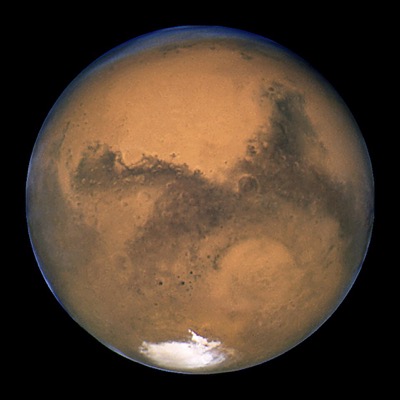
MARS

火星 ― 赤く輝く砂漠の世界 Mars ― The Red Desert World
火星 / Mars

画像: NASA(パブリックドメイン)Image: NASA (public domain)

太陽からの距離DISTANCE
1.52 AU
直径DIAMETER
6,779 km
公転周期ORBIT
687日687 d
衛星MOONS
2

概要

火星は太陽系で内側から4番目をめぐる岩石惑星で、地球のすぐ外側を公転しています。表面が酸化鉄(いわゆる「さび」)を多くふくむ砂と岩におおわれているため、全体が赤茶色に見え、古くから「赤い惑星」と呼ばれてきました。

大気は地球と比べてとても薄く、その大部分は二酸化炭素です。地球の数百分の一ほどしか気圧がないため、表面に液体の水を長くとどめておくことはできません。それでも砂嵐が惑星全体をおおうほど大気の動きは活発で、季節によって表情を変えます。

特徴

火星には太陽系で最大の火山オリンポス山がそびえています。その高さはおよそ22kmにおよび、地球のエベレストのおよそ2倍以上に達します。また、長さおよそ4,000kmにわたる巨大な峡谷マリネリス峡谷が赤道付近を横切り、惑星の地形のなかでもひときわ目を引きます。

両極には水や二酸化炭素の氷からなる白い「極冠(きょっかん)」があり、季節とともに大きくなったり小さくなったりします。

1日の長さ(自転周期)は地球とほぼ同じで約24.6時間。さらに自転軸が公転面に対してかたむいているため、地球と同じように四季が生まれます。火星に親しみを感じやすいのは、こうした地球との共通点があるからかもしれません。

豆知識

2つの小さな衛星 — 火星はフォボスとダイモスという2つの小さな衛星を従えています。どちらもいびつな形をした岩のかたまりで、捕らえられた小惑星ではないかとも考えられています。

かつての水の痕跡 — 火星の表面には、かつて液体の水が流れていたとみられる川や湖のあとが数多く見つかっています。水の存在は生命の可能性とも結びつくため、火星は生命探しの有力候補とされています。

たくさんの探査車 — そうした理由から、火星はこれまでに数多くの探査機や探査車(ローバー)が送りこまれてきた惑星です。将来の有人探査の目的地としても、もっとも現実味のある候補に挙げられています。

Gravity Weaver での攻略

火星は太陽系ステージの4番目(9ステージ中4つ目)。太陽のかけらを引力場で導き、火星へ到達させればクリアです。

このステージから新たに星雲(Nebula)が登場します。星雲の中を通過すると太陽のかけらは減速するため、軌道の組み立て方が一気に奥深くなります。星雲をうまく避けて勢いを保つか、あえて通して速度をゆるめ着地をねらうか——状況に応じて引力場の描き方を変えていきましょう。

Overview

Mars is the fourth rocky planet from the Sun, orbiting just outside Earth. Its surface is covered with sand and rock rich in iron oxide — in other words, rust — which gives the whole world a reddish-brown hue and has earned it the long-standing nickname "the Red Planet."

Its atmosphere is very thin compared with Earth's and is mostly carbon dioxide. With only a few hundredths of Earth's surface pressure, liquid water cannot remain on the surface for long. Even so, the air is active enough for dust storms to engulf the entire planet, and Mars changes its appearance with the seasons.

Features

Mars is home to Olympus Mons, the largest volcano in the solar system. It rises about 22 km high — more than twice the height of Mount Everest on Earth. The planet also features Valles Marineris, an enormous canyon system roughly 4,000 km long that stretches across the equatorial region and stands out among its landforms.

At both poles sit white "polar caps" made of water and carbon dioxide ice, which grow and shrink with the seasons.

A day on Mars (its rotation period) is about 24.6 hours — almost the same as Earth's. Because its axis is also tilted relative to its orbital plane, Mars experiences four seasons just as Earth does. These shared traits may be part of why Mars feels so familiar to us.

Trivia

Two small moons — Mars is accompanied by two tiny moons, Phobos and Deimos. Both are irregularly shaped lumps of rock, and they may be captured asteroids.

Traces of past water — The Martian surface bears many signs of rivers and lakes where liquid water once flowed. Because the presence of water is tied to the possibility of life, Mars is considered a leading candidate in the search for life.

Many rovers — For these reasons, Mars has received more probes and rovers than almost any other planet. It is also the most realistic candidate as a destination for future crewed exploration.

In Gravity Weaver

Mars is the fourth stage of the solar system run (4th of 9). Guide the Solar Shard with your gravity fields and bring it to Mars to clear the stage.

From this stage onward, nebulae make their debut. Passing through a nebula slows the Solar Shard down, which makes shaping its trajectory far more interesting. Should you steer clear to keep your momentum, or pass through on purpose to bleed off speed and line up a landing? Adjust how you draw your gravity fields to fit the moment.

主なデータKey Data

太陽からの平均距離Mean distance from Sun1.52 AU
直径(平均)Diameter (mean)6,779 km
公転周期Orbital period687 日687 days
自転周期Rotation period約24.6時間~24.6h
平均表面温度Mean surface temp.約-63℃~-63°C
衛星の数Moons2(フォボス・ダイモス)2 (Phobos, Deimos)

太陽系ステージに挑戦しようChallenge the solar system stages

PLAY NOW